From Laudato Sí’ to Magnifica humanitas: ‘Human Dignity is Non-Negotiable’
Part 1 of our conversation launching the FOWLS Symposium Cycle looks back on ten years of the FOWLS Project, highlights unique contributions of faith-based organizations in age of new technologies affecting work
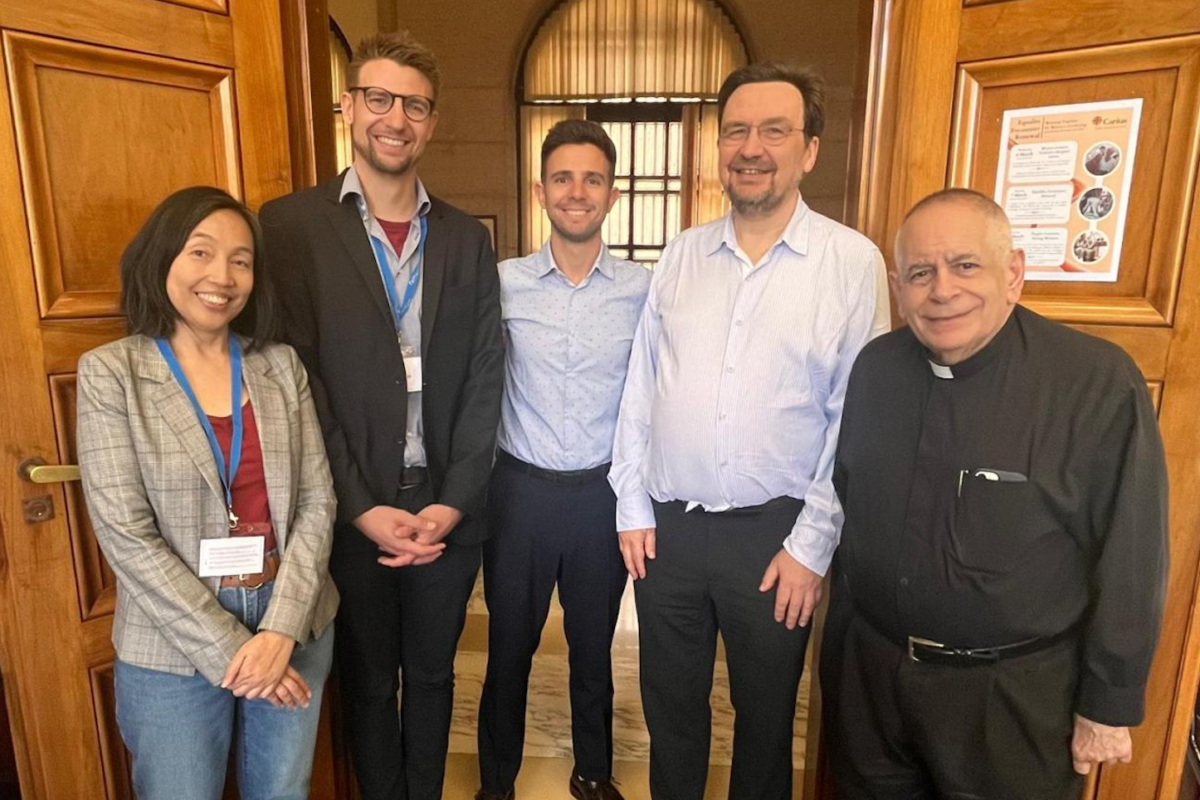
In Part 1 of our conversation feature marking the first FOWLS Project Symposium, taking place in Rome on 16-18 June, we sit down with Ignacio Alonso-Alasino (ICMC and the FOWLS Project), Pierre Martinot-Lagarde (International Labour Organization) and Athena Peralta (World Council of Churches).
Read Part 2 of the conversation ‘An Invitation to Construct Solutions Together’.
***
ICMC: Thanks so much all for your time today. Could you maybe start by introducing yourselves, and saying something about your work with the FOWLS Project?
IAA: Thanks for having us! I’m Ignacio, originally from Argentina and serving as the FOWLS Project Manager at ICMC. I’ve coordinated the FOWLS Project for ICMC for the past decade, bringing together actors from the world of labor, civil society, and faith, to foster dialogue and collaboration on work, migration, artificial intelligence (AI)I, and social justice.
PML: I’m Pierre, and I work at the International Labour Organization (ILO), where I am in charge of outreach to civil society organizations, including faith-based organizations. I’ve been developing the FOWLS Project in cooperation with ICMC for the past ten years, as a bridge between the world of work, the ILO, the Catholic Church, and other faith groups.
AP: And I’m Athena, from the Philippines, and currently the Director of the Commission on Climate Justice and Sustainable Development at the World Council of Churches (WCC). WCC is a fellowship of 356 churches in more than 100 countries, borne out of the ‘Life and Work’ churches movement addressing post-Second World War realities of widespread joblessness, deplorable working conditions, and lack of social security. So it’s absolutely in line with our mission that we are involved as a key partner in the FOWLS Project, developing the ‘Care is Work, Work is Care’ theme, and contributing to discussions on climate change and just transitions.
ICMC: We’re speaking ten years after the second encyclical of Pope Francis, Laudato Si’, prompted the establishment of the FOWLS Project. Today, what are the specific contributions of faith-based organizations to international cooperation and advocacy on work and social justice? How does the FOWLS Project network contribute?
AP: Faith-based organizations bring a powerful, values-based message: that justice and care for all creation are at the core of God’s vision for the world, and that human dignity is non-negotiable. We have a more holistic understanding, in which the economy is connected to both society and the environment, which is why we are working for just transitions in the context of the climate emergency. We also nurture local and global networks that lift up the voices of the marginalized, and provide a platform to advocate on key issues such as the living wages and climate protection for migrant workers.
We are facing a ‘moment of choice’: AI can either foster shared prosperity or deepen inequalities, depending on how it is governed.
Ignacio Alonso-Alasino, FOWLS Project Manager at ICMC
As faith-based organizations, we are called to address pressing contemporary issues such as modern-day slavery, child labor, migration, and climate-related displacement. To have an enduring impact, we have to work together. We share resources and knowledge and coordinate our efforts, thereby building a more unified and influential voice in the public debates. The FOWLS Project provides a platform for envisioning, discussing, and planning together, with a common vision of global social justice.
PML: I think the specific contribution of faith-based organizations is to remind us that our future is in our hands, if we cherish common values. We cannot look at the future solely on the basis of profit, but must rather emphasize the centrality of human values to building a common future.
All our institutions, including the UN system and the ILO, have been built on core values. They were created with the hope that social justice would be conducive to peace, and this gives us direction. The role of faith-based organizations is to help imagine a world where those values are central. More essentially, they serve as reminders that if we do not care for our deepest, highest values, it will be difficult – if not impossible – to build a future together.
ICMC: How has the world of work changed in the ten years since the FOWLS Project, and what does the framework provided by Laudato Si’ offer in this new global context?
PML: This is a very important but difficult question. Firstly, we have witnessed the impact of growing inequalities, not so much amongst people who earn their living from salaries and work, but rather between this group and those who earn money from finance. Secondly, the COVID-19 pandemic demonstrated the vulnerability of the world of work, the challenges it faces, and the importance of the care dimension. This had already been emphasized by Pope Francis in the encyclical, but the pandemic created a renewed emphasis.
Thirdly, what was already anticipated has further developed: the impact of new technologies on the world of work, by which we mean both AI and other forms of automation and robotization. Finally, there is environmental change, and while we have emphasized climate, we are increasingly witnessing broader challenges related to environmental disruption.
Faith-based organizations bring a powerful, values-based message: that justice and care for all creation are at the core of God’s vision for the world, and that human dignity is non-negotiable.
Athena Peralta, Director of the Commission on Climate Justice and Sustainable Development at the World Council of Churches (WCC)
I think Laudato Si’ gives us clear direction, in its substantive conceptual innovation of emphasizing the shared responsibility to care for our common home. ‘Care’ has deep meaning when applied to the world of work, and helps us question our traditional understandings of what work is and is for. Laudato Si’ also raises the same deep question of the technological‑technocratic paradigm that is a key theme of Pope Leo in Magnifica humanitas. We now need to find new paths that do not simply follow the directions set by that paradigm.
ICMC: Thanks for mentioning Magnifica humanitas: On Safeguarding the Human Person in the Time of Artificial Intelligence, the first encyclical of Pope Leo XIV published in May. Ten years after Laudato Si’, what guidance does Pope Leo’s encyclical provide for the FOWLS Project in addressing the impact of technology for the world of work?
IAA: Magnifica humanitas offers essential guidance by warning against a technocratic paradigm that prioritizes efficiency over ethics and the common good. Its calls for a human-centered approach to AI, ensuring that technological progress serves the integral development of the human person and society, is a vision that closely aligns with the FOWLS approach.
Magnifica humanitas also contributes to ongoing debates on how AI is reshaping labor, particularly regarding algorithmic management, worker autonomy, and the concentration of data and power. It’s a message that we’ve emphasized in international discussions, for example at the recent International Labor Conference (ILC). We are facing, as the ILO Director-General’s report to the ILC says, a ‘moment of choice’: AI can either foster shared prosperity or deepen inequalities, depending on how it is governed.
The key question that resonates in our world today is peace: will this tool increase or decrease peace, and how can it bring more peace to a world that is suffering?
Pierre Martinot-Lagarde, Special advisor on religious affairs at the International Labour Organization
PML: For me, two words from the encyclical provide an answer to your question: ‘discernment’ and ‘disarmament’.
‘Discernment’ is not only about choosing good and avoiding evil, but about finding a better way among possible future paths. It relates to action: that we are not just observing the world, but considering specific actions we, as people of God, should undertake. This idea is central to our work, because our methodology is based on the conviction that the path we need to follow must be discerned together involves engaging together in common social discernment.
The encyclical strongly invites engagement in the common social discernment process and synodal journey of togetherness: our common future and common good are to be discerned together.
In this global moment, ‘disarmament’ is specifically about disarming AI. AI can do a lot of good when used and governed properly, but like any new tool with potential benefits and harms it also needs to be disarmed. The key question that resonates in our world today is peace: will this tool increase or decrease peace, and how can it bring more peace to a world that is suffering?
IAA: It’s also important to consider AI alongside other technological developments affecting the world of work. A key concern for us is the expansion of platform-based work, for example, a sector in which migrants are overrepresented. Here, new technology often shifts risks onto workers while limiting access to rights and protections, compounding existing vulnerabilities and deepening inequality. For FOWLS, this is a moral issue, as it directly affects the dignity of work, social protection, and accountability in the digital economy.