ICMC Joins Coalition Raising Interfaith Voices at the International Migration Review Forum
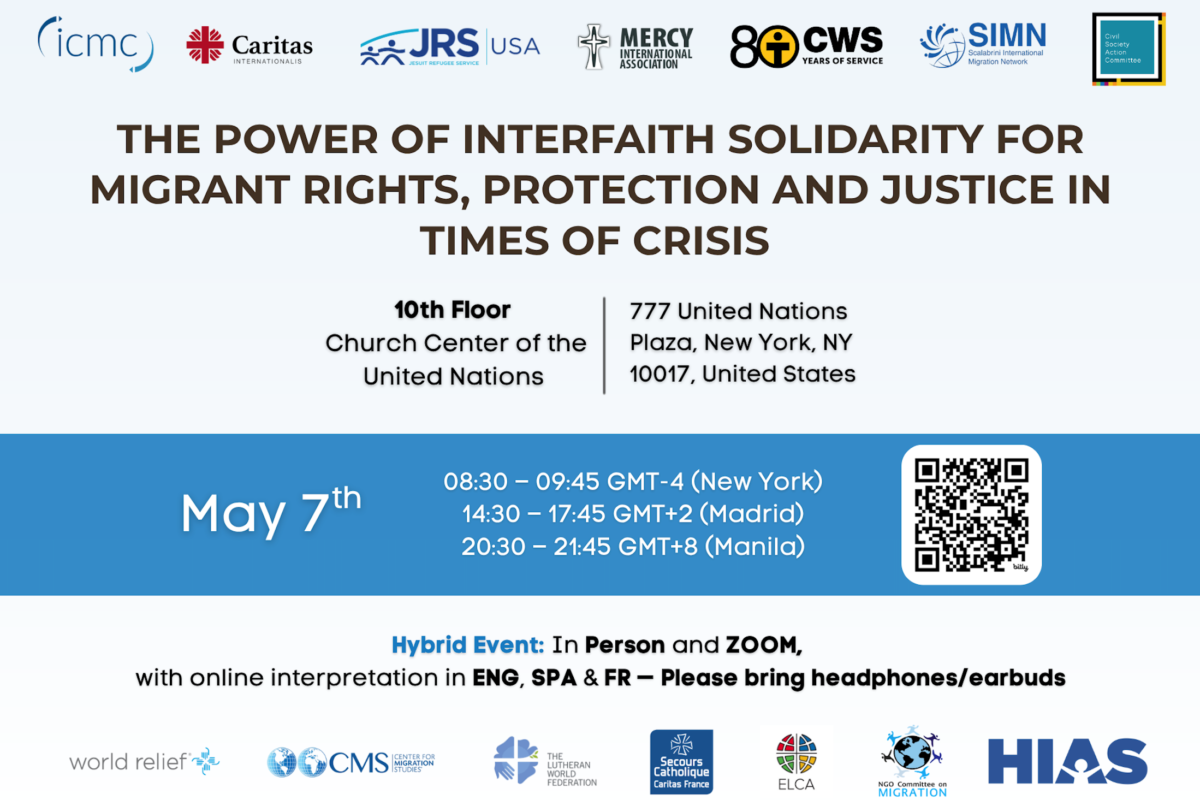
Side event at IMRF in New York highlights crucial contributions of faith-based organizations to assisting refugees and migrants, addressing global migration challenges
The second International Migration Review Forum (IMRF)*, took place in New York on 5-8 May. The IMRF is convened every four years to review progress in implementing the 2018 Global Compact for Migration (GCM)* and set the direction for future cooperation and action. Civil society participation in the IMRF is supported by the Civil Society Action Committee, an independent global civil society network coordinated by ICMC.
On Thursday 7 May, ICMC joined a coalition of 14 faith-based organizations* hosting The power of interfaith solidarity for migrant rights, protection and justice in times of crisis, a hybrid IMRF side event held at the Church Centre for the United Nations. Initiated by discussions between Caritas Internationalis, Church World Service, Jesuit Refugee Service USA, the NGO Committee on Migration, and ICMC, the event brought together approximately 80 participants, both online and in person.
“This second IMRF takes place amidst a global climate of polarized instability and anti-migration sentiment”, said Elana Wong, Coordinator of the Civil Society Action Committee for ICMC, speaking ahead of the event. “As such, it is a critical opportunity for key international actors in the global faith-based landscape to assert our unity in the pursuit of human rights for all.”
‘Unity is fundamental’: interfaith solidarity as a response to global challenges
Discussions took place in a wider context of multiple global challenges for refugees, migrants, and those working to assist them, and speakers highlighted the essential role of interfaith cooperation and solidarity in developing an effective response.
We must bring the flag of faith to political advocacy, because migration policy is an ethical question: ‘Against human suffering, what is my responsibility, and what is our responsibility?’ This question requires an ethical response, from both the Church and society
Johana Morales Quiroga, Evangelical Lutheran Church of Colombia
“Unity is fundamental: we are all competing for reduced funds, and we need to be aware that this may become a way to sow division,” said Victor Genina of Caritas Internationalis.
Touching on the multiple challenges presented by increasingly restrictive migration policies around the world, Monsignor Robert Murphy, Chargé d’Affaires a.i at the Permanent Mission of the Holy See to the United Nations, emphasized the importance of solidarity in action. “We see the growing practice of externalizing migration governance, arbitrary detention, removals and deportations, and the separation of children from families and caregivers,” he said. “That’s the context in which concrete solidarity, including interfaith solidarity, is so important.”
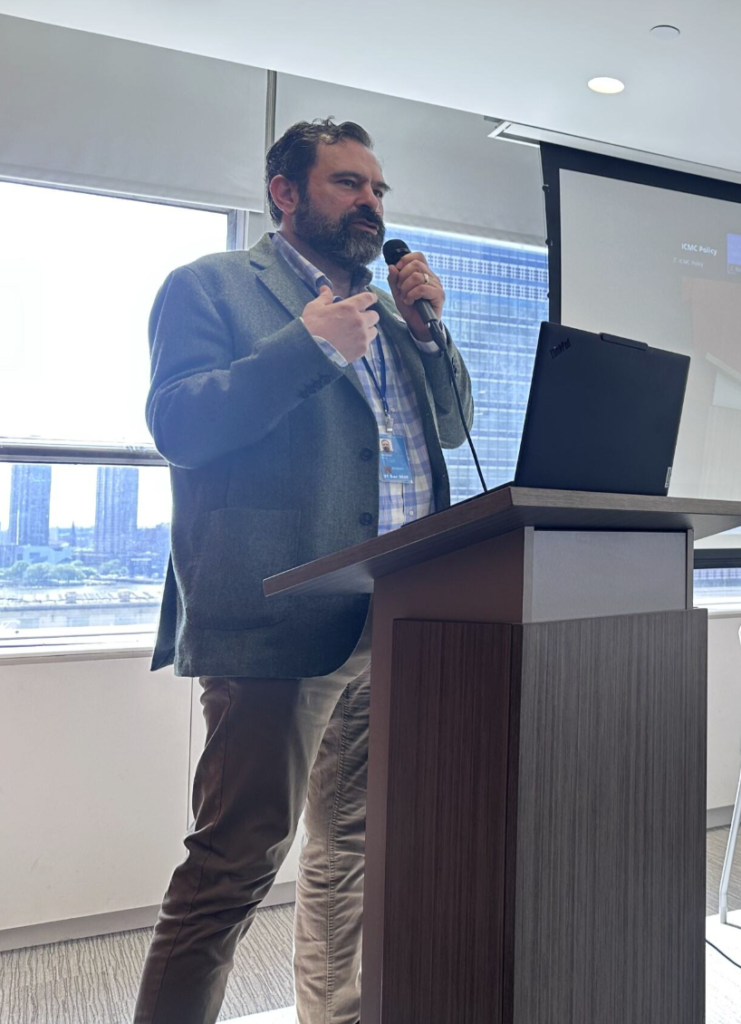
In many contexts, this solidarity extends to an active role for faith communities and organizations in advocating for improved migration policy.
“We need structural change, so as faith-based organizations our job cannot be limited solely to assistance,” said Johana Morales Quiroga, Migrant Pastoral Coordinator at the Evangelical Lutheran Church of Colombia. “We must bring the flag of faith to political advocacy, because migration policy is an ethical question: ‘Against human suffering, what is my responsibility, and what is our responsibility?’. And this question requires an ethical response, from both the Church and society.”
Noah Gottschalk of HIAS noted how advocacy can ensure that the expertise of faith-based organizations on the ground impacts discussions at international level. “Faith communities are already on the ground in every crisis around the world, as part of the affected communities. They are key partners in identifying and developing solutions, in particular in so-called forgotten crises. ‘Forgotten by whom?’ is a good question: they’re certainly not forgotten by the affected communities, so our collective work is to make sure they’re not forgotten by the international community.”
Faith-based organizations: Trusted first responders & essential global partners
The event showcased the crucial role of faith communities and organizations in assisting migrants and refugees, and progressing commitments set out in the Global Compact for Migration.
“The Compact explicitly acknowledges faith communities as centrally important to the successful implementation of its objectives,” stated Msgr. Murphy. “We provide a human approach, encompassing assistance with basic needs, emotional support, spiritual accompaniment, and advocacy, and we also help to build the strong community relations that are preconditions for successful integration.”
In the more than half-century before the suspension of the U.S. resettlement program, it was faith-based organizations that ensured millions of vulnerable refugees were resettled
Kelly Ryan, Jesuit Refugee Service USA
In a context of global reductions in funding for humanitarian assistance, faith communities and institutions are essential first responders in emergencies.
“Where state responses are limited, local communities face multiple challenges to respond to emergencies,” said Morales Quiroga. “Churches are among the first places to welcome people, and that’s why it’s so important that we support local Church responses, as we have in Colombia, so they can provide refuge in complicated contexts where there is no institutional assistance.”
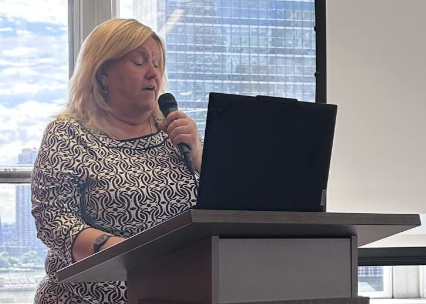
Kelly Ryan of Jesuit Refugee Service USA outlined how faith-based organizations have long been at the center of global efforts to protect refugees: “In the more than half-century before the suspension of the U.S. resettlement program, it was faith-based organizations that ensured millions of vulnerable refugees were resettled.”
She also emphasized how, at the local level, faith-based institutions are trusted and integral parts of communities. “The unique trust of communities, alongside our longstanding and continuous community presence, are absolutely crucial,” she explained. “More than 200 people are currently sheltering in St Joseph’s Church in Beirut, for example, a large number of whom are the same people who sheltered there during the 2024 bombings. People of all faiths are there, because they trust in the safety and protection that this church will provide.”
Assisting people on the move: A spiritual imperative
Event speakers described a shared moral imperative to assist refugees and migrants for faith-based organizations, grounded in spiritual and theological teachings.
“Across faith traditions, the treatment of people on the move has never been a peripheral concern but rather a moral imperative,” stated Msgr. Murphy. “As Catholics, we are guided by a rich body of doctrine and tradition developed over 2,000 years, that is now being tested by ideas of migrants as a threat and the use of religion to fuel anti-migration narratives. But as Pope Leo said: “A religion without mercy and a society without solidarity are a scandal in God’s eyes”, and Church teachings help people to see that migrants are our brothers and sisters.”
Assisting migrants and refugees is also an example of faith as meaningful action, and a crucial component of communicating with the faithful.
“The work that faith-based organizations do for those on the move around the world is the work of God: it’s a spiritual imperative,” said Professor Azza Karam, CEO of Lead Integrity and former Secretary General of Religions for Peace. “This not only deepens our assistance to encompass a spiritual component, but also shows the faithful that their religion is doing more than just talking. Faith-based organizations have the task of both explaining and doing.”
***
* Caritas Internationalis, Civil Society Action Committee (includes some members here), Church World Service, Center for Migration Studies, HIAS, International Catholic Migration Commission, Lutheran World Federation, Mercy International Association, NGO Committee on Migration (includes some members here), Jesuit Refugee Services USA, Scalabrinian International Migration Network, Secours Catholique-Caritas France, World Relief.

Rachel Westerby
Independent writer and researcher on migration and refugees.