‘Our motivations are shaped by the migrant experience’
Marking this month’s International Women’s Day, we sat down with Elana Wong and Oumou Diallo from ICMC’s Advocacy Team to reflect on their work in ICMC’s 75th anniversary year
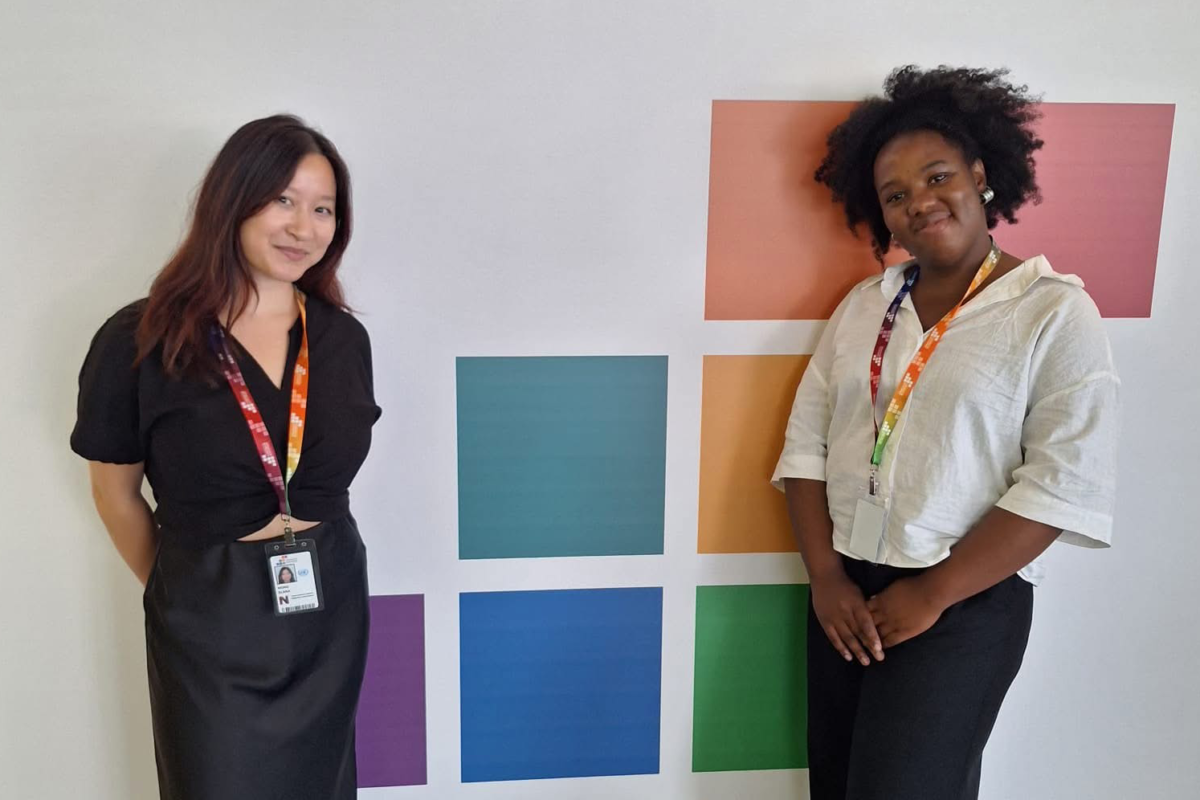
To mark this month’s International Women’s Day, celebrated on Sunday 8 March, we’re celebrating the ICMC women driving our mission to serve and protect people on the move.
The ICMC Advocacy Team is a global facilitator of coordinated civil society engagement in global migration processes and policymaking. The team serves as the Secretariats of the Civil Society Action Committee, a network of 60+ civil society partners around the world, and of the Civil Society Mechanism of the Global Forum for Migration and Development (GFMD)* process.
To find out more about the team, and to reflect on the work and mission of ICMC in our 75th anniversary year, we sat down with Elana Wong (Team Coordinator) and Oumou Diallo (Policy & Communications Officer) in Geneva.
***
ICMC: Hi Elana and Oumou, and thanks a lot for joining us. Maybe we can start with what drew you both to working with ICMC, and more generally to the field of migration, refugees, and human rights?
EW: Good to be here! I started working with ICMC three years before I joined the organization, in my role with the Migration Youth & Children Platform, a Civil Society Action Committee member, and I joined the ICMC Advocacy Team in 2023.
OD: I was drawn to the opportunity with ICMC for both the civil society organizing and communications elements, and the contribution I could make to joint civil society advocacy across a range of migration themes.
EW: In answer to the broader part of your question, it’s also very personal. I am both a migrant and from a family with a history of migration. My grandparents on both sides left China before and during the Communist Revolution and migrated to Southeast Asia, and my parents were amongst the first and second generations born in Malaysia and Singapore. I then migrated to the United Kingdom, and have stayed in Europe ever since.
My university education took place throughout the height of the media focus on the ‘refugee crisis’ in Europe, and that’s what directed my interest and commitment toward migrant and refugee rights. As a privileged migrant with access to resources and support, I feel a deep sense of responsibility to fight for an equal and just world. I want to work to ensure that human rights, dignity, and support are the norms for everyone, everywhere.
OD: I really recognize that, in that I’m also a migrant myself, born in Guinea and raised in Italy. Since I moved, migration has shaped much of my personal and professional experience. Thanks to family reunification, at age six I was able to reunite with my mother in Italy, where I grew up. While Italy is the place I call home, living between two cultures and different identities also shaped my perspectives, especially in a country where migration was and is complex.
One particularly important experience for me was in 2015, when anti-migration discourse in Italy was especially prominent, and anti-migration and xenophobic rhetoric began to permeate discussions among my school classmates. It was then that I realized I needed practical tools, data, and knowledge to counteract these narratives. So I focused my university studies on international migration and diaspora, and now I’m with ICMC. So it’s a different experience for sure, but in both cases our motivations are shaped by both a migration background and the migrant experience.
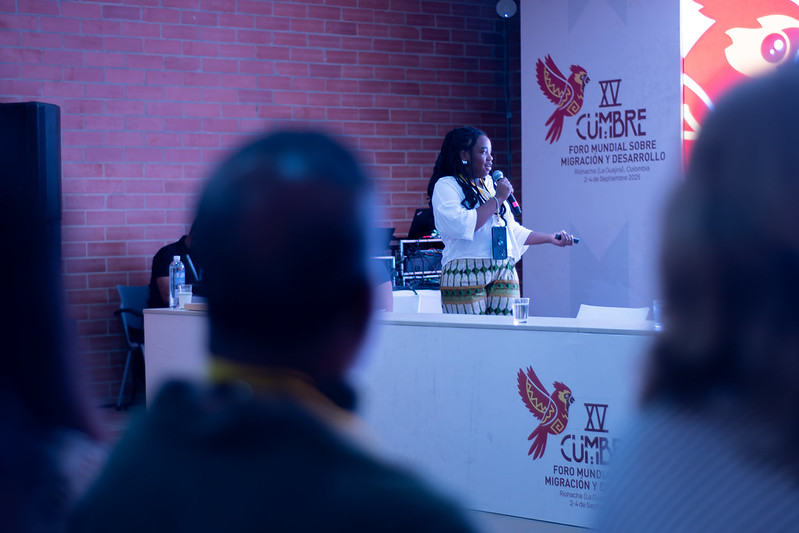
ICMC: What value does global coordination of civil society advocacy bring to migration and governance and policymaking? What impact does ICMC’s work have?
EW: I think firstly we provide a lot of support in terms of synthesizing and disseminating the information that enables civil society to participate in intergovernmental and international migration governance. We really simplify processes, and by doing so we increase democratization and accessibility.
We also build solidarity and partnerships, providing the historical institutional memory of civil society participation, retaining learning, challenges, and recommendations, and bringing them into decision-making and governance spaces
OD: Exactly! I also think that ICMC’s coordination of civil society has gone far beyond simply bringing stakeholders together, and now focuses on building capacity to mobilize, take action, and drive change. Coordination is much more than logistical organization – it requires strategic direction, which we’ve been able to build into ICMC’s global coordination role.
ICMC: The work of your team takes you all over the world. Could you share a personal highlight from your time with ICMC?
OD: For me it’s the Abuja Civil Society Forum, held in Nigeria when I’d just joined ICMC. As someone so new to the position, it provided me with invaluable early insight into the work. It was the first time I’d truly witnessed the power and dynamism of civil society collectivization in action, and this experience has continued to energize me throughout my time at ICMC.
EW: I’d say it’s hard to pin it down to one memory or moment. All of us on the team are from migrant backgrounds, and I’m proud that we’ve built a team of migrants working to help and support migrants everywhere.
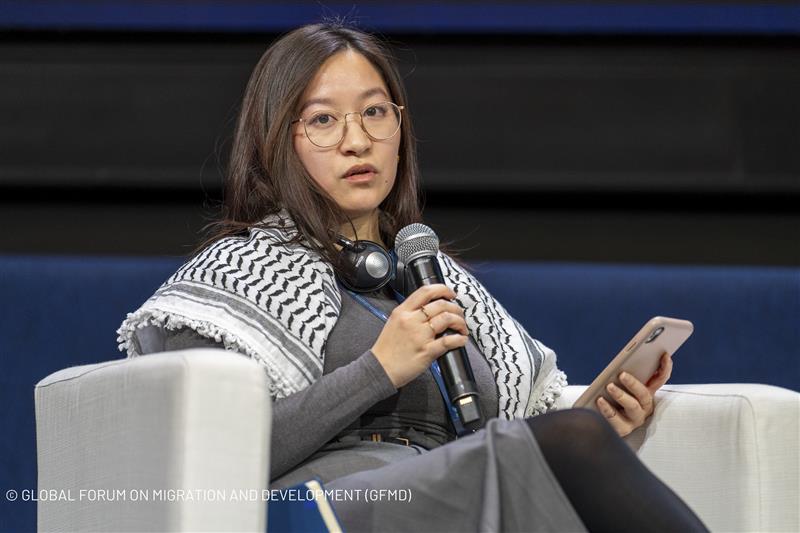
OD: As we’re talking in ICMC’s 75th anniversary year, I’d also like to add that beyond the work of our team, I think ICMC has for the past 75 years shown that it upholds a core commitment to the human dignity of migrants and refugees. The organization has also continually shown its adaptability, working for 75 years across emergencies to protect uprooted people in different parts of the world and respond to needs as they arise. This ability to adapt while still pursuing the core mission of protecting refugees and uprooted people is more important than ever. For our team, I think this capacity is what makes us effective in convening our network in a global context of reduced resources, instability, and rapid change.
EW: I’m also proud to see the progress we’ve made in building and expanding civil society collaborative and solidarity-building spaces, even in the face of challenges. Resources are scarce, obstacles are constantly evolving, and civic space worldwide is closing. Yet even working with less, we keep creating spaces for reflection, discussion, and innovation, and responding to the needs of migrant communities and civil society around the world.
***
* The GFMD is a state-led, informal, and non-binding process that helps shape the global debate on migration and development and allows governments – in partnership with civil society, the private sector, local and regional governments, youth and other relevant stakeholders – to analyze and discuss sensitive issues, create consensus, pose innovative solutions, and share policy and practices.

Rachel Westerby
Independent writer and researcher on migration and refugees.