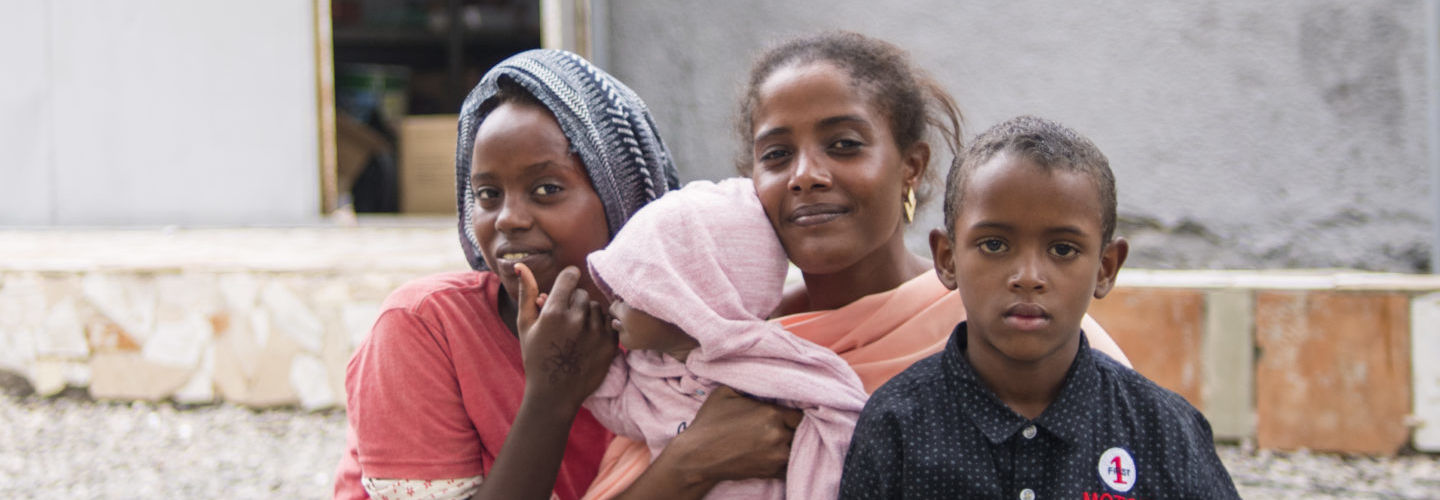
ICMC was created in 1951 to unite and organize existing Catholic associations and committees, and to promote, reinforce, and coordinate their activities on behalf of migrants and refugees. For 75 years, we have protected and served uprooted people, including refugees, asylum-seekers, internally displaced people, victims of human trafficking, and migrants – regardless of faith, race, ethnicity or nationality.
Origins
Initiated by the joint efforts of Pope Pius XII, Monsignor Giovanni Battista Montini (Vatican Secretary for Relations with States and future Pope Paul VI) and layman James J. Norris, ICMC was created to support Catholic organizations in responding to the needs of displaced persons and refugees.
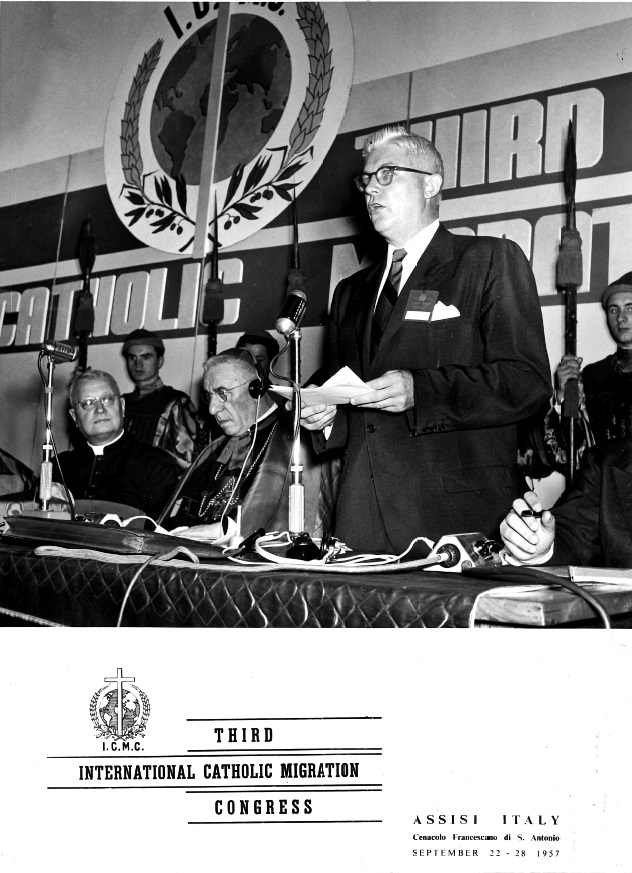
Following the Second World War, the efforts of Msgr. Montini and James Norris for the displaced victims of war assumed an even greater urgency with the growing exodus of refugees fleeing to the West from the Soviet bloc countries of Eastern Europe.
Shortly after its creation, the ICMC Secretariat was established in Geneva, Switzerland, with the aim of collaborating closely with the newly created United Nations bodies on migration (IOM) and refugee issues (UNHCR). In 1952, ICMC was granted consultative status with the United Nations Economic and Social Council (ECOSOC). In its early years, the work of ICMC focused on the administration of migrant travel loan funds. ICMC soon gained comprehensive expertise in assisting migrants and increased its network of member organizations and local partners, thus becoming a worldwide movement.
1970s
By the 1970s, the migration phenomenon had become more complex and international.
In 1975, James Norris – who had by then been President of ICMC for over 20 years – won the UNHCR Nansen Refugee Award, the highest UNHCR recognition for “extraordinary service to the forcibly displaced.”
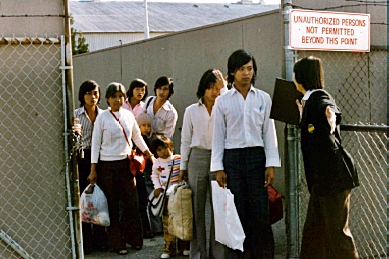
In 1979, after “boat people” fleeing Vietnam perished at sea, ICMC played a major role in providing legal and safe means of emigration, mainly by resettling refugees from Vietnam to the United States through the Orderly Departure Program. ICMC also began resettlement work with new refugee groups from South-East Asia, the Near East, Africa, and Latin America.
During the program’s nearly 20 years of operation, over 500,000 people were resettled, mainly to the United States.
1980s and 1990s
In the early 1980s, ICMC began to work in the resettlement of refugees from Turkey to the United States, in partnership with the United States Department of State’s Bureau of Population, Refugees and Migration (BPRM). The Resettlement Support Center for Turkey and the Middle East based in Istanbul, Turkey, became one of ICMC’s largest operations.
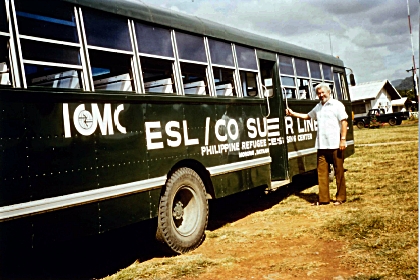
While continuing working in the Soviet Union between the 1980s and the 1990s, ICMC also played a leading role during the war in Yugoslavia: as violence continued to escalate in the Balkans, the ICMC office in Zagreb processed thousands of resettlement applications, mainly by Bosnian Muslims seeking support to emigrate towards the United States. In 1997, ICMC also opened three microcredit institutions (in Serbia-Montenegro and Kosovo) providing business loans, training and counseling to the uprooted people wishing to start a new activity.
In 1998, ICMC initiated a partnership with the UN Refugee Agency (UNHCR) through the ICMC-UNHCR Resettlement Deployment Scheme. The Scheme consists of a pool of experts from diverse backgrounds, who are ready to be deployed on short notice to UNHCR’s field operations in Africa, the Middle East, Asia, and Latin America whenever crucial support is needed.
2000s
In 2001, the events of 11 September in the United States caused a major change in world politics. As the United States entered Afghanistan, large numbers of Afghani refugees began returning home after many years in neighboring countries. ICMC took immediate action and started its largest-ever operation assistance in Afghanistan: over 70,000 people returning from Pakistan and Iran were sheltered in camps.
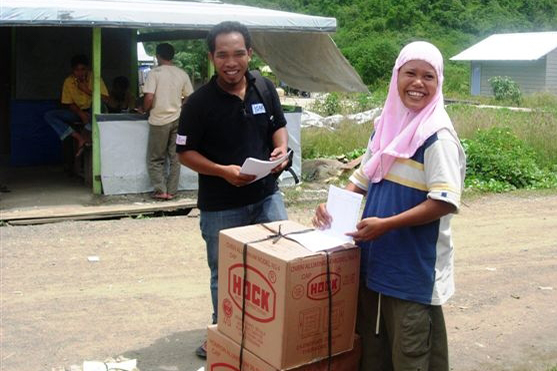
ICMC’s focus shifted again towards South-East Asia in 2004, as the world rushed to respond to the devastating tsunami, caused by an earthquake recorded as the strongest of the 21st century, which hit the Indonesian coasts. ICMC had been granted access in Aceh in 2001. Thus, it was already present in Indonesia when the tsunami struck and was able to respond immediately to the devastation caused, both at the community and individual levels.
To reflect the increasingly important role of the European Union in migration and asylum policymaking, ICMC Europe was established in 2004. In 2007, together with the UN Refugee Agency UNCHR and the International Organization for Migration (IOM), ICMC Europe founded the European Resettlement Network (ERN), a collaborative initiative to increase the engagement of European countries in receiving resettled refugees.
2010s
2010 saw the founding of ICMC Malaysia, a women-led team dedicated to combating sexual and gender-based violence (SGBV) for refugees and asylum seekers in Malaysia, and offering emergency protection and assistance to SGBV survivors. Until its closure in 2025, ICMC Malaysia supported more than 10,000 SGBV survivors, trained educators working with refugee and migrant children, and worked with a team of refugee volunteers to raise SGBV awareness amongst refugee communities.
In 2011, ICMC was selected as the leading organization in charge of coordinating the Civil Society Mechanism of the Global Forum for Migration and Development (GFMD), a role that we have maintained to date. The GFMD is a state-led, informal, and non-binding process that helps shape the global debate on migration and development and allows governments – in partnership with civil society, the private sector, local and regional governments, youth and other relevant stakeholders – to analyze and discuss sensitive issues, create consensus, pose innovative solutions, and share policy and practices. The Civil Society Mechanism coordinated by ICMC gathers together more than 700 organizations globally.
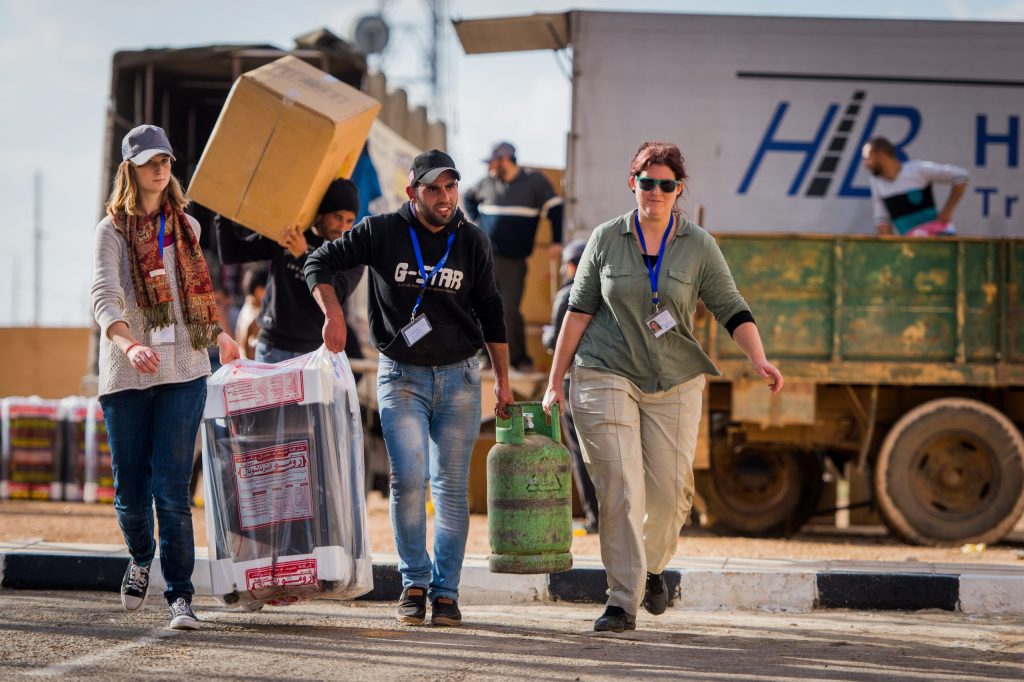
Political instability in the Middle East since the beginning of 2011 – notably the Syrian civil war – caused mass displacements in the region. ICMC, active in the Greater Damascus area since 2006, started a number of projects focusing on Iraqi refugees settled in Syria, displaced people fleeing the conflict into Jordan and vulnerable people within the host Jordanian communities.
March 2012 saw ICMC Europe establish the Share Network, an inclusive network of EU-based communities and actors engaged in the welcome and inclusion of newcomers in Europe. Share focuses on connecting and engaging with local European actors and communities interested in or working in the areas of refugee and migrant inclusion, refugee resettlement, complementary pathways of admission, refugee sponsorship, and relocation. From 2012, the Share Network’s focus expanded to include work on approaches that benefit all newcomers to the EU, including refugees, asylum seekers, labor migrants, unaccompanied minors and victims of trafficking.
Following the 2015 publication of Laudato Si’ , Pope Francis’ Encyclical Letter on Care For Our Common Home, ICMC worked together with the Holy See, the International Labour Organization (ILO), Caritas Internationalis, the Catholic-inspired organizations working group on decent work, and other religious organizations to convene the Global Seminar on Sustainable Development and the Future of Work.
The event explored the transformative message of Laudato si’ for labor, inequality, and care. It also marked the birth of what became today’s “The Future of Work – Labour after Laudato Si’” (FOWLS) project, a global initiative founded in 2016 and coordinated by ICMC, exploring the future of work through the lens of Laudato si’. Today, the project engages Vatican institutions, trade unions, business associations, interfaith actors, academia, grassroots organizations, and youth movements in advocacy for policies that recognize ‘care is work, work is care’, emphasizing the inseparable link between work, care, and the protection of our common home.
2020s
From the early 2020s, smaller and rural communities were playing an increasingly significant role in receiving newcomers to the EU. To support this new engagement, from 2021 ICMC Europe’s Share Network offered tailored training and capacity-building for these communities, and established a refugee participation program to ensure the voices of beneficiaries could shape programmes and policymaking.
In 2022, ICMC was a founding partner of the CR4U initiative to coordinate Church responses in Ukraine, which to date has supported a wide range of Church partners to implement actions focused on psychosocial health and humanitarian assistance. As the war in Ukraine persists, ICMC continues to support Church responses and stand in solidarity with those affected.
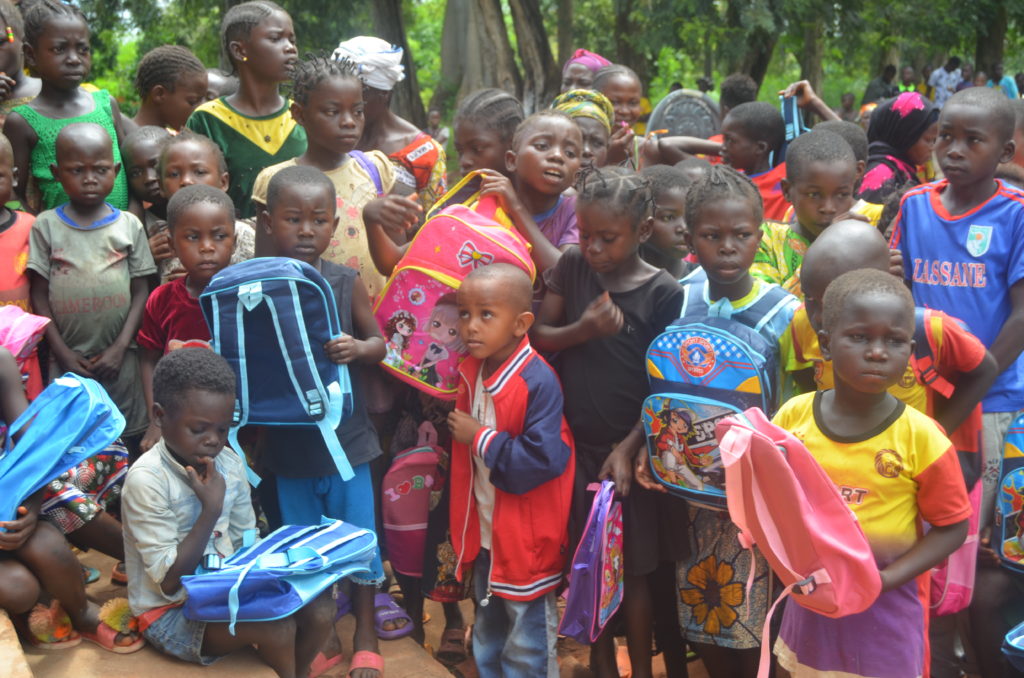
Since 2022, ICMC has supported member national Bishops’ Conferences in 14 countries around the world to implement projects and actions for refugees and migrants. These actions have focused predominantly on child protection, safeguarding and education, livelihoods training and entrepreneurship support, and health and mental health, with smaller investments in actions for humanitarian assistance and shelter.
2024 marked a critical point of consolidation and strengthening for the ICMC-coordinated FOWLS Project. In May, FOWLS network members and stakeholders gathered in Rome to reflect on their experiences and produce a joint roadmap for future engagement and action. The event had the great honor of being received by Pope Francis in a private audience, during which he reaffirmed his simple but powerful message: “Care is work, work is care.”
2025 brought unprecedented global reductions in resources for humanitarian assistance and development. Following the general suspension of funding for the U.S. Refugee Admissions Program and foreign assistance, ICMC – as many other humanitarian organizations – made the difficult decision to downsize by cutting critical services to refugees and people displaced by war and persecution in several countries in the world.
Despite this challenging start to the year, the ICMC family drew hope from the election of Pope Leo in May, and from ’Migrants, missionaries of hope’, his message for the 111th World Day of Migrants and Refugees, which in 2025 coincided with the Jubilee of Migrants and of the Missions celebrated on 4-5 October.
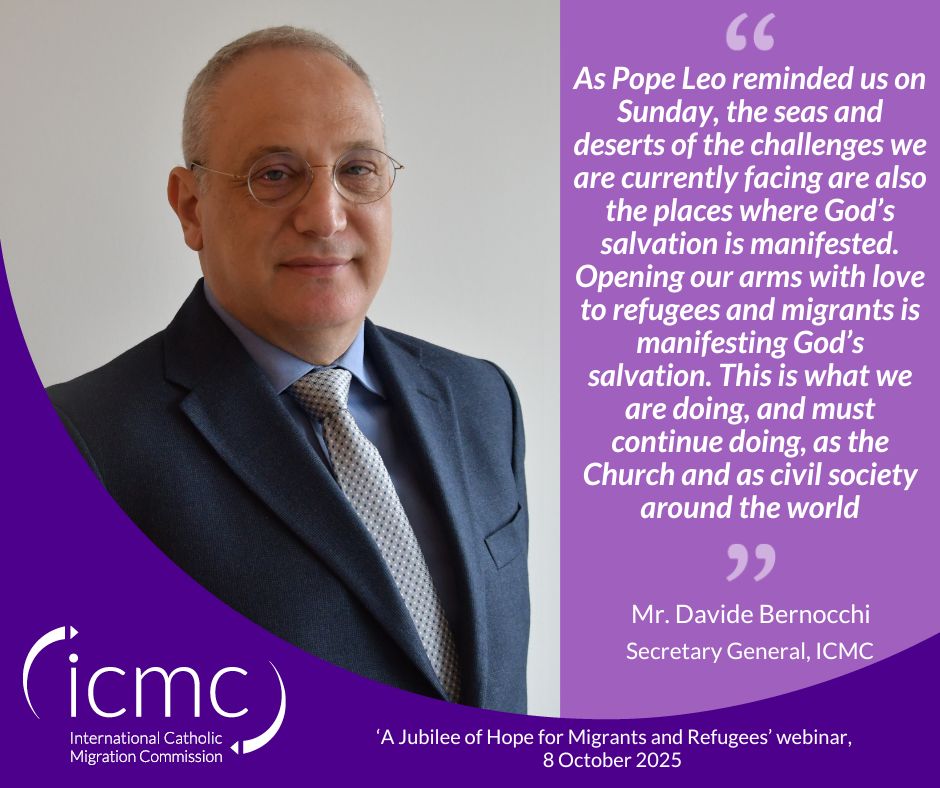
On 8 October, the Geneva Forum of Catholic-Inspired Organizations, on the initiative of ICMC, facilitated ‘A Jubilee of Hope for Migrants and Refugees: Faith and Human Rights Perspectives’, a webinar bringing together representatives from the Church, international organizations, faith-based organizations, and grassroots civil society, to reflect on the Jubilee’s message in relation to the current challenges experienced by migrants, refugees, and those assisting them. The webinar was sponsored by the Vatican’s Dicastery for Promoting Integral Human Development, and broadcast via Vatican Media in English, French, and Spanish.